
A New Buzzword for a Not So New Breakthrough
If you have attended any AV trade show in 2025 or 2026, or browsed the spec sheets of recent dvLED display launches, you have probably encountered the term “cold DVLED” or “cold LED.” The marketing pitch sounds revolutionary: displays that run dramatically cooler than traditional LED video walls, slashing energy bills and freeing facility managers from oversized HVAC systems. It is a compelling story. It also happens to describe a technology that has existed for years under a different, more technically accurate name: flip-chip common cathode chip-on-board, or flip-chip COB.
This article unpacks what cold DVLED actually means at the silicon level, why operating temperature has become such a critical factor in large-scale display deployments, and how the Zavus XP line from Jupiter Systems has been delivering these exact advantages since before the term “cold LED” entered the industry vocabulary. We will also go beyond the thermal story, into the total cost of ownership implications, HVAC engineering, sustainability certifications, and long-term reliability gains that make this technology shift genuinely consequential for anyone specifying or operating a dvLED video wall.
What Does Cold DVLED Actually Mean?
The term “cold DVLED” describes dvLED displays that operate at significantly lower temperatures than conventional products built with surface mount diode (SMD) LED packages. Where a traditional SMD dvLED wall can radiate substantial heat from both the front and rear of the panel, requiring aggressive air conditioning to keep the room and the electronics within safe operating limits, a cold DVLED display generates markedly less thermal energy for the same amount of visible light output.
That sounds like a breakthrough in materials science, and in a sense it is. But the underlying technology is not new. What has changed is that manufacturers across the industry are now adopting the architecture and giving it consumer-friendly branding. The technology making “cold” operation possible is flip-chip common cathode COB, a fundamentally different way of building and powering the LED die that has been in production for several years.
Flip-Chip Common Cathode COB: The Architecture Behind the Marketing
To understand why cold DVLED displays run cooler, you need to understand what changed at the component level compared to traditional SMD construction.
SMD: The Incumbent Approach
In a conventional SMD LED display, individual LED packages, each containing red, green, and blue sub-pixels, are soldered onto the surface of a printed circuit board. Each package has its own tiny plastic housing, wire bonds connecting the die to the leads, and exposed solder joints. This construction method has served the industry for over a decade and is well understood, but it carries inherent limitations. The wire bonds introduce electrical resistance, which generates heat. The LED packages are physically exposed to the environment, making them vulnerable to electrostatic discharge (ESD), moisture ingress, and mechanical damage. And the common anode power architecture used in most SMD designs delivers a uniform voltage to all three sub-pixel colors, even though red, green, and blue LEDs have different optimal forward voltages, wasting energy as heat in the process.
Flip-Chip Common Cathode COB: A Ground-Up Redesign
Flip-chip COB takes a fundamentally different approach at every layer of the stack. Instead of mounting packaged LEDs on the board surface, the bare LED die is flipped and bonded directly to the substrate, eliminating wire bonds entirely. This direct metallurgical connection reduces electrical resistance and improves thermal conductivity, because the heat generated by the junction has a shorter, lower-resistance path to the heat sink.
The “common cathode” part of the name refers to the power delivery architecture. Instead of driving all three colors at the same voltage and burning off the difference as heat, a common cathode design supplies each sub-pixel color with its own optimized voltage. Red LEDs, which need a lower forward voltage than blue or green, receive exactly what they need instead of having excess energy dissipated as waste heat. The result is a measurably more efficient electrical-to-optical conversion at the die level.
Finally, the chip-on-board (COB) encapsulation process coats the entire pixel area in a smooth, protective black resin. This encapsulation does double duty: it protects the LED die from ESD, physical contact, oxygen, and moisture, while also improving the optical contrast ratio by absorbing ambient light between pixels. The surface is smooth to the touch, not a grid of tiny exposed packages, and mechanically far more resilient than an SMD array. Our detailed comparison of COB versus SMD LED video wall technology covers this architectural distinction in depth.
Why Display Temperature Is Not Just a Spec Sheet Number
At first glance, the fact that one display technology runs cooler than another might seem like a minor engineering detail, useful on a comparison table but hardly a deciding factor in a purchasing decision. In practice, the thermal profile of a dvLED wall has cascading consequences that affect nearly every line item in the project budget, from construction through a decade of daily operation.
HVAC: The Cost You Sized the Room Around
Every watt of electrical power consumed by a display that does not leave the front of the panel as visible light leaves as heat, and that heat has to go somewhere. In a typical operations center running a large SMD dvLED wall 24 hours a day, 7 days a week, the cooling load from the display alone can represent a significant portion of the room’s total HVAC requirement. Mechanical engineers size chillers, ductwork, and air handling units to remove that heat, and in purpose-built facilities, the HVAC infrastructure behind a video wall can rival the cost of the displays themselves.
A display that converts a larger share of its electrical input into light rather than heat reduces that cooling requirement proportionally. Lower heat output means smaller HVAC equipment, lower peak electrical demand for cooling, and a smaller mechanical footprint behind the wall, which in turn frees up valuable real estate in the equipment room. For retrofit projects where the existing HVAC system is already at capacity, a cooler-running display can be the difference between a straightforward upgrade and a six-figure mechanical engineering project.
Reliability: Heat Is the Enemy of Longevity
Semiconductor reliability follows well-understood physics. For every 10°C increase in junction temperature, the useful life of an LED roughly halves. A display technology that runs at a fundamentally lower operating temperature is not just more comfortable to stand near, it is protecting the investment at the molecular level, extending the useful life of every LED on the wall. This is why specifications like “100,000 hours typical lifetime” are not just numbers. They are projections rooted in the thermal environment the LED actually operates in, and a cooler architecture reaches that figure with more margin to spare.
Total Cost of Ownership: The Number That Actually Matters
AV integrators and procurement teams understandably focus on the purchase price, because that is the capital expenditure that hits the budget immediately. But from the end-user’s perspective, the total cost of ownership (TCO) over the full lifecycle of a dvLED wall, typically eight to twelve years, is where the real financial picture emerges. TCO includes the purchase price, installation, ongoing electrical consumption, HVAC operating costs, maintenance and repair, and eventual decommissioning. A display that costs slightly more up front but consumes dramatically less power and requires far less cooling and maintenance will almost always deliver a lower TCO over its operational life.
The Metric That Should Be on Every Spec Sheet: Nits per W/m²
For years, the standard metric for evaluating dvLED power consumption has been watts per square meter (W/m²). This figure tells you how much electrical power the display draws for a given area, and it is useful for calculating electrical panel sizing and, indirectly, HVAC load. But it tells you nothing about how efficiently that power is being converted into the thing you actually bought the display for: visible light.
A more revealing metric is nits per W/m², which measures how many nits (candelas per square meter) of sustained luminance the display produces for every watt per square meter it consumes. Because nits are derived from candela (lumens per steradian), this ratio effectively captures the display’s electrical-to-optical energy conversion efficiency. Two displays can consume the same 400 W/m², but if one produces 1,000 nits of sustained luminance and the other produces only 400, the first is converting far more of its electrical input into useful light rather than waste heat.
This is the metric that separates genuinely efficient display architectures from those that simply dim the backlight to hit a lower wattage number. A higher nits per W/m² figure means more light for less electricity, less waste heat, lower HVAC costs, and ultimately a lower total cost of ownership over the life of the installation.
Zavus XP: The Numbers That Back the Claim
The Zavus XP product line is built on flip-chip common cathode COB architecture with a proprietary power management chip that is shared across all three pixel pitch variants. This unified power management platform means the efficiency gains are not limited to a single model; they are engineered into every Zavus XP display regardless of pitch. The COB chip itself delivers 30% improved energy efficiency compared to standard common cathode COB implementations, which were already ahead of SMD.
Here is how the three current Zavus XP models compare, using the nits per W/m² metric calculated from their published specifications. All three sustain over 1,000 nits of calibrated luminance.
Zavus XP7 (0.7mm pixel pitch)
Power consumption: 440 W/m² maximum, 171 W/m² typical. At 1,000 nits sustained luminance, that yields a power efficiency of 2.27 nits per W/m². Heat dissipation: 1,500 BTU/hr per square meter maximum, 583 BTU/hr typical. The XP7 is the finest pitch in the Zavus XP line, designed for close-viewing command centers where operators sit within a few feet of the display surface for extended periods.
Zavus XP9 (0.9mm pixel pitch)
Power consumption: 385 W/m² maximum, 121 W/m² typical. At 1,000 nits sustained, that delivers 2.60 nits per W/m², the highest efficiency figure in the lineup. Heat dissipation: 1,313 BTU/hr per square meter maximum, 413 BTU/hr typical. The XP9 represents the sweet spot for many enterprise deployments, balancing pixel density with efficiency.
Zavus XP12 (1.2mm pixel pitch)
Power consumption: 489 W/m² maximum, 182 W/m² typical. At 1,000 nits sustained, that yields 2.04 nits per W/m². Heat dissipation: 1,668 BTU/hr per square meter maximum, 621 BTU/hr typical. The XP12 covers larger viewing distances where the wider pixel pitch is visually indistinguishable from finer options, making it the most cost-effective entry into COB MicroLED.
How That Compares to the Industry
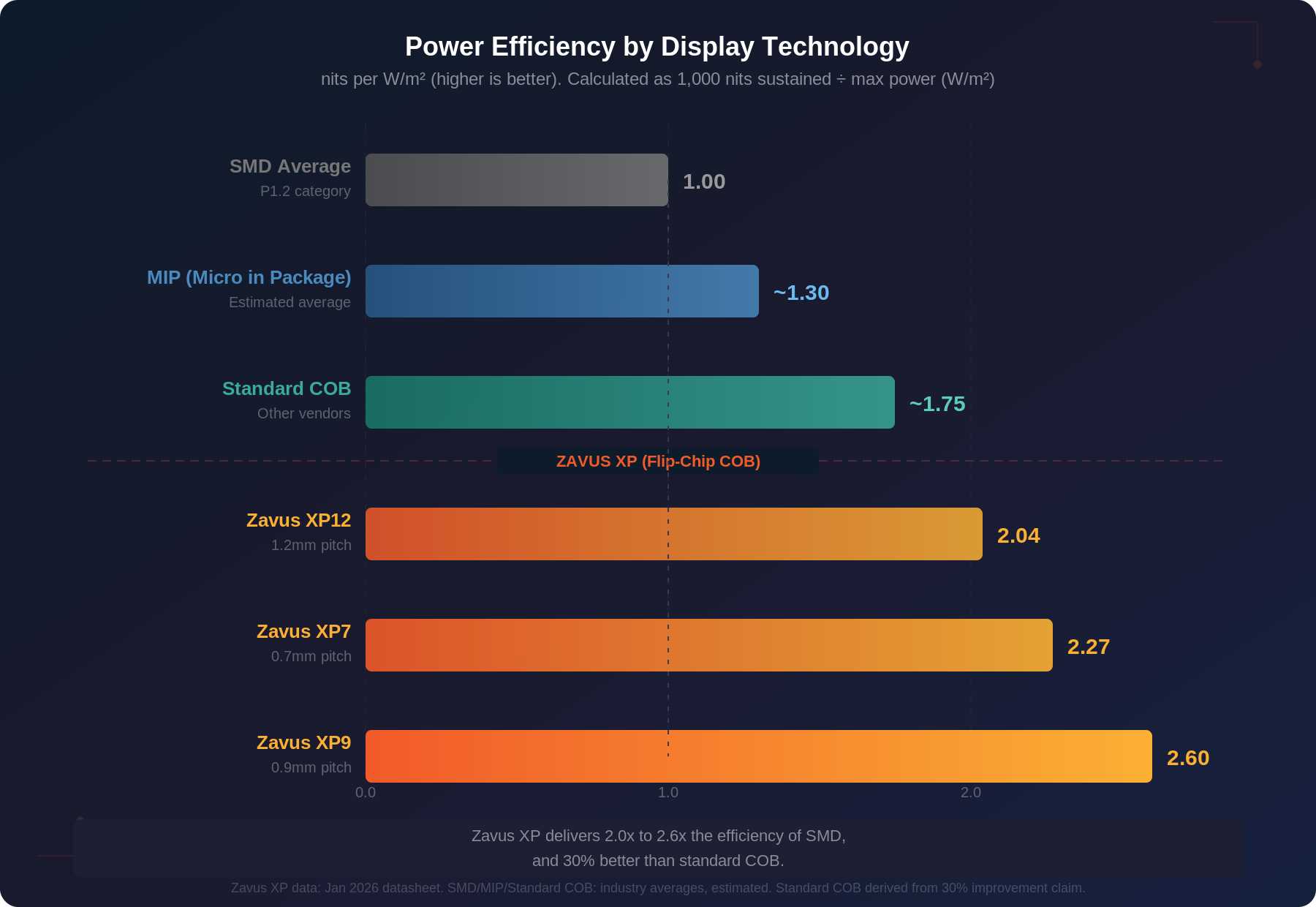
The dvLED market today spans four distinct technology tiers, each with a different efficiency profile. Traditional SMD sits at the bottom at around 1.00 nit per W/m². MIP (micro-LED in package), a newer assembly method that improves on SMD but retains some of its thermal limitations, reaches approximately 1.30. Standard common cathode COB products from other manufacturers push to roughly 1.75, a meaningful improvement over SMD but still constrained by conventional power management. The Zavus XP line, with its proprietary power management chip delivering 30% better efficiency than standard COB, reaches 2.04 to 2.60 nits per W/m² depending on pixel pitch.
That range matters because it tracks directly to how much of each electrical watt becomes light versus heat. An SMD wall and a Zavus XP9 wall can both sustain 1,000 nits, but the SMD wall consumes 2.6 times more power to get there, and every excess watt becomes heat that the HVAC system must remove. Even compared to other COB vendors, Zavus XP converts measurably more power into useful light. These efficiency figures are calculated against the maximum power draw, which is the most conservative method. At typical operating levels, where most displays spend the vast majority of their runtime, the real-world efficiency advantage is even greater.
From Cold DVLED to Lower TCO: How the Efficiency Advantage Compounds Over Time
The connection between “cold” operation and long-term cost savings is not a marketing leap. It is arithmetic. Every watt that a display consumes without converting into visible light becomes waste heat, and that waste heat triggers a chain of costs that repeat every hour, every day, for the entire operational life of the installation. A cold DVLED display built on flip-chip common cathode COB breaks that chain at the source by producing more light per watt and less heat per nit. But here is the critical insight: not all COB is created equal. Even within the COB category, the gap between standard implementations and the Zavus XP architecture is significant enough to change the TCO outcome over a five-year operating cycle.
It is also worth addressing the purchase price question directly. SMD displays are the least expensive to buy, followed by MIP, then standard COB, with premium flip-chip COB like Zavus XP carrying the highest upfront cost. That purchase price hierarchy is exactly inverted from the operating cost hierarchy, and the crossover point where the cheaper-to-buy technology becomes the more-expensive-to-own technology arrives sooner than most procurement teams expect.
The Direct Electricity Savings
Consider a 10-square-meter dvLED wall running 24 hours a day, 365 days a year, which is a standard configuration for a network operations center or security operations center. At typical operating levels, the Zavus XP9 draws 121 W/m², translating to a total display load of approximately 1.21 kW. A comparable SMD wall delivering the same 1,000 nits of sustained brightness at the industry-average efficiency of 1.00 nit per W/m² would require roughly 400 W/m² under typical conditions, totaling approximately 4.0 kW. That difference of 2.79 kW, running continuously, adds up to 24,440 kWh per year. At a national average electricity rate of $0.12 per kWh, the display power alone saves over $2,900 annually. Even a standard COB wall at roughly 229 W/m² typical would draw 2.29 kW, nearly double the Zavus XP9’s load.
The HVAC Multiplier Effect
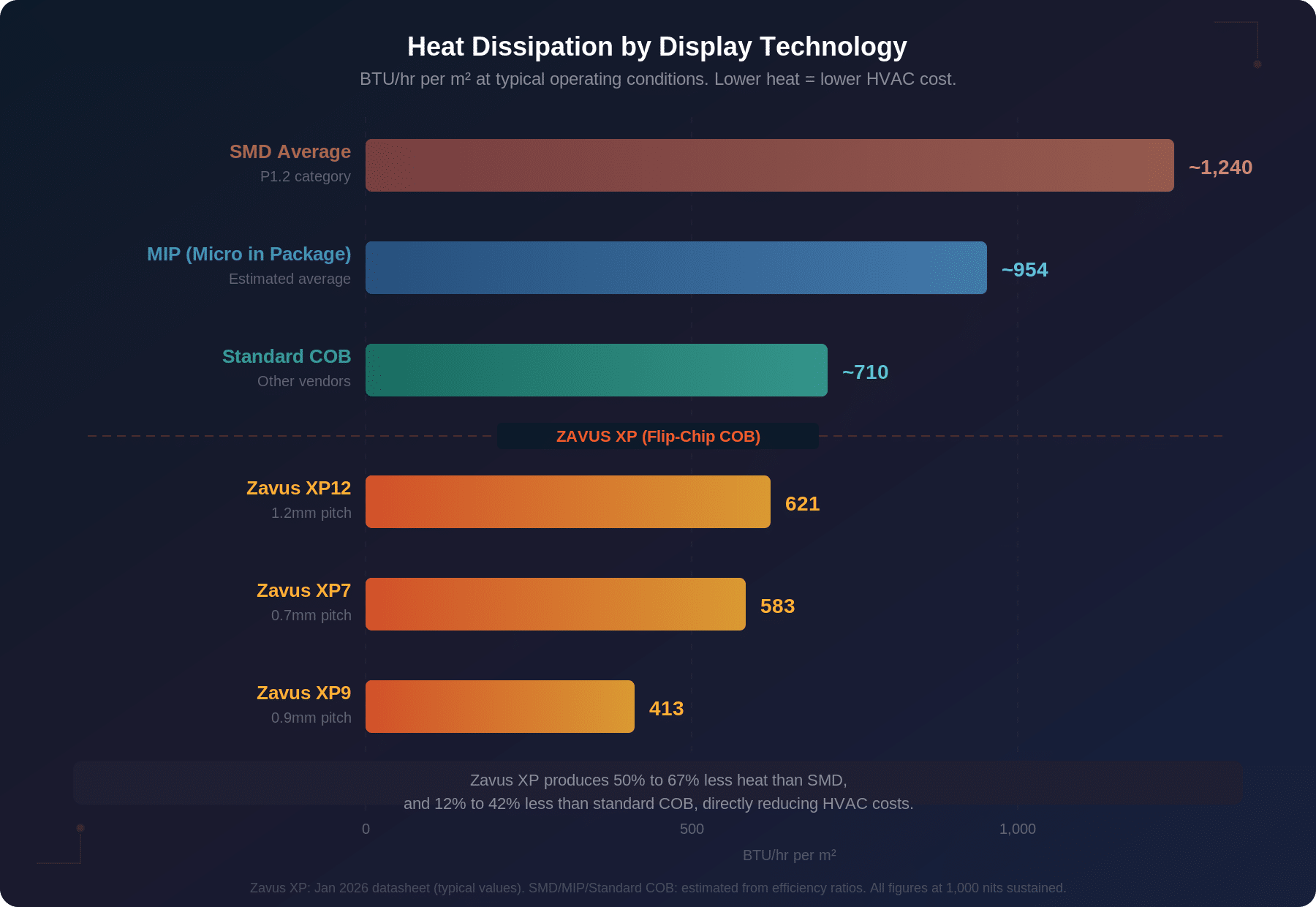
The electricity bill for the display is only part of the story. Every BTU of heat the display injects into the room must be removed by the HVAC system, and removing heat requires additional electrical power. The Zavus XP9 produces 413 BTU/hr per square meter under typical conditions. A comparable SMD wall produces roughly 1,240 BTU/hr per square meter. MIP falls around 954 BTU/hr, and standard COB around 710 BTU/hr. For a 10 m² wall, the building’s cooling system must handle anywhere from 4,130 BTU/hr (Zavus XP9) to 12,400 BTU/hr (SMD), a three-to-one ratio.
Using a standard coefficient of performance (COP) of 3 for a commercial HVAC system, the cooling energy required to remove the Zavus XP9’s heat is approximately 0.40 kW, while the SMD wall’s cooling load demands approximately 1.21 kW. Standard COB sits at roughly 0.69 kW and MIP at 0.93 kW. This is the “multiplier effect” of cold DVLED: every watt saved at the display cascades into additional watts saved at the HVAC system. The most efficient display does not just cost less to power, it costs less to cool.
The 5-Year Cumulative Picture

When you combine the direct display power savings with the HVAC multiplier effect, the total annual energy cost (display electricity plus cooling) for a 10 m² wall looks very different depending on which technology is behind it. SMD costs approximately $5,603 per year to power and cool. MIP comes in at $4,215, standard COB at $3,133, and Zavus XP9 at just $1,692. Over five years, those annual differences compound into substantial gaps: SMD accumulates $28,015 in energy costs, while Zavus XP9 totals just $8,460, a $19,555 savings in energy alone. Even compared to standard COB at $15,665, Zavus XP9 saves over $7,200 in five years.
Scale that to a 20 or 30 square meter installation common in major operations centers and the five-year savings versus SMD approach $40,000 to $60,000. At that scale, the difference in upfront purchase price between SMD and premium flip-chip COB is substantially offset, or entirely recouped, by the operating cost advantage within the first few years of operation.
These calculations do not even account for three additional cost advantages that further separate cold DVLED in a TCO analysis. First, the reduced HVAC capacity required at installation, because the mechanical engineering for a cooler wall costs less in capital equipment, ductwork, and electrical panel capacity. Second, the maintenance savings from COB encapsulation, which we address in the next section, reducing module replacements and service calls over the wall’s lifetime. Third, the extended useful life of LEDs operating at lower junction temperatures, potentially pushing the replacement timeline well past the five-year mark. The TCO advantage of cold DVLED is not a single-line savings. It is a structural reduction in the cost of operating a large-scale display, and the most efficient flip-chip COB implementation delivers the largest structural advantage.
Beyond Power: Why COB Encapsulation Changes the Maintenance Equation
The thermal efficiency of flip-chip common cathode architecture is the headline, but the COB encapsulation that defines the Zavus XP construction method delivers a second set of advantages that directly affect operational reliability and maintenance costs.
Traditional SMD displays expose individual LED packages to the environment. Every package has solder joints, wire bonds, and surfaces that can be damaged by static discharge during installation or servicing, by moisture in humid environments, by dust accumulation in industrial settings, or simply by an accidental touch during maintenance. Over years of 24/7 operation, these vulnerabilities accumulate. Individual pixels fail, requiring module-level replacements that introduce color and brightness mismatches, create downtime, and add ongoing maintenance labor costs to the total cost of ownership.
Zavus XP’s fully encapsulated COB construction eliminates these exposure points. The entire pixel surface is sealed under a smooth black resin that is immune to ESD, resistant to physical contact, and impervious to oxygen and moisture. The result is reliability that exceeds competing SMD offerings by a factor of five, according to Jupiter’s testing, with a typical lifetime of 100,000 hours of continuous operation. For a display running 24/7, that translates to over eleven years before reaching the rated lifetime threshold, during which the maintenance burden is a fraction of what an equivalent SMD installation would require.
The environmental protection rating reinforces this point. Zavus XP carries IP65 on the rear and IP54 on the front, protecting against dust and water ingress from both sides. For deployments in industrial environments, transportation hubs, or any facility where airborne contaminants are a concern, that level of protection significantly reduces the risk of environmentally induced failures. For a broader understanding of how MicroLED technology achieves these advantages, our MicroLED display technology guide provides a comprehensive overview.
LEED, ESG, and the Sustainability Angle
Climate change regulations and corporate sustainability commitments are no longer a distant concern for facilities teams. Standards such as LEED building certification are gaining wide adoption among business leaders, and energy-efficient building systems, including the display infrastructure that can run 24 hours a day in operations-critical environments, contribute directly to certification scores. A dvLED wall that draws half the power and produces half the waste heat of an equivalent SMD installation does not just save money. It moves the needle on measurable sustainability metrics that increasingly factor into corporate real estate decisions, lease negotiations, and public reporting.
For organizations tracking ESG (Environmental, Social, and Governance) metrics, the power consumption of always-on display infrastructure is a line item that internal sustainability teams and external auditors can see. Specifying a display technology that demonstrably converts more electricity into light and less into waste heat is one of the more straightforward ways to improve the energy performance of a purpose-built facility, especially in environments like network operations centers, security operations centers, and command centers where the video wall is the single largest electrical load after the HVAC system itself. Our dedicated look at the key considerations for upgrading a command and control room addresses how sustainability goals increasingly shape procurement decisions in these environments.
The Image Quality That Efficiency Does Not Sacrifice
A common concern when evaluating energy-efficient display technology is whether the efficiency gains come at the cost of image quality. In the case of flip-chip common cathode COB, the answer is the opposite: the same architecture that reduces power consumption and heat also enables superior image performance.
Zavus XP delivers over 1,000 nits of sustained luminance after calibration, which is the brightness level maintained continuously under real operating conditions, not a peak burst figure that the display can only hit momentarily. The 1,000,000:1 contrast ratio produces perfect blacks and clean separation between dark and bright content, which matters in 24/7 monitoring environments where operators are scanning dense dashboards and live video feeds simultaneously. The color gamut covers 100% of sRGB/Rec.709, 96% of DCI-P3, and 80% of Rec.2020, with up to 32-bit color depth for internal processing. Color uniformity is controlled to within +/- 0.003 CIExy, less than one JND (just noticeable difference), ensuring that a white background or a skin tone looks identical from one cabinet to the next across a wall that may span dozens of individual modules.
The scan rate, up to 5,760 Hz on the XP7 and XP9 models, makes the display camera-friendly for broadcast and virtual production environments where moiré patterns and banding artifacts would be unacceptable. Response time is under one microsecond, and the viewing angle of 170° in both horizontal and vertical planes means the image holds up for operators positioned anywhere in the room, not just dead center. The 28mm cabinet depth makes Zavus XP one of the thinnest MicroLED products available, simplifying surface mounting and reducing the structural requirements for wall installations.
What This Means for Your Next dvLED Project
The “cold DVLED” trend is real in the sense that the industry is finally recognizing what flip-chip common cathode COB technology has delivered for years: displays that run dramatically cooler, last significantly longer, and convert more of their electrical input into useful light. The branding is new, but the engineering is proven. If you are evaluating dvLED displays for a new build or a wall replacement, here is what the efficiency conversation should actually focus on.
Ask for the nits per W/m² figure, not just the W/m² figure. Two displays at the same wattage can have wildly different optical output, and the one that produces more light for less power is the one that will cost less to cool and less to operate for the next decade. Look at the heat dissipation numbers and map them against your mechanical engineer’s HVAC capacity, because a cooler-running display may eliminate the need for a supplemental cooling system entirely, saving capital and ongoing energy costs. And consider the encapsulation method, because a display that is immune to ESD, moisture, and mechanical damage will need less maintenance intervention over its operational life.
If you are scoping a MicroLED project and want to work through pixel pitch and panel count before engaging an integrator, Jupiter’s Zavus calculator is a fast way to get sizing numbers in front of a budget conversation. For a deeper understanding of how COB construction compares to SMD alternatives, see our COB versus SMD comparison. And to explore the full Zavus XP product line, including detailed specifications for all three pixel pitch options, visit the Zavus XP product page or reach out through Jupiter’s contact page to discuss your specific project requirements.


